By Ray Baker
Three in ten U.S. adults say they have used an online dating site or app, and a majority of online daters say their overall experience was positive, according to a Pew Research Center survey conducted Oct. 16 to 28, 2019.
But dating after 70 and widowed is not a numbers game. It is about whether you can hold loss and hope at the same time without feeling disloyal to the life you had.
Is dating after 70 and widowed a good idea?
It can be a good idea when it is something you want, not something others expect. Your loss does not expire, and there is no fixed waiting period. The right pace is one that leaves room for grief, honesty, safety and a small amount of curiosity about good company.
Key takeaways
- Grief and openness can exist side by side, but only you can decide when the balance feels bearable.
- A slow, social-first approach usually works better than rushing into a committed relationship.
- The National Institute on Aging notes that loneliness and social isolation are associated with higher risks for health problems, so rebuilding safe contact matters.
- Choosing whether to date is yours alone, not your family’s decision.
- Feeling disloyal, hopeful and frightened in the same week is normal.
If you want to meet other older singles, Dating for Seniors is a site built for that.
Visit Dating for Seniors
What makes it different after 70?
Age changes the practical side of dating more than the emotional need for connection. Hearing loss, vision changes, reduced night driving and a smaller circle of friends can make meeting people harder than it was at 50 or 60.
The National Institute on Aging notes that older adults are at higher risk for social isolation and loneliness due to changes in health and social connections that can come with growing older, hearing, vision, and memory loss, disability, trouble getting around, and/or the loss of family and friends. A PubMed search for ‘widowhood dating older adults’ returns search results on the topic.
If you were widowed earlier, the emotional baseline can feel quite different; I have written separately about dating after 60 and widowed, and that may be a better fit for your stage.
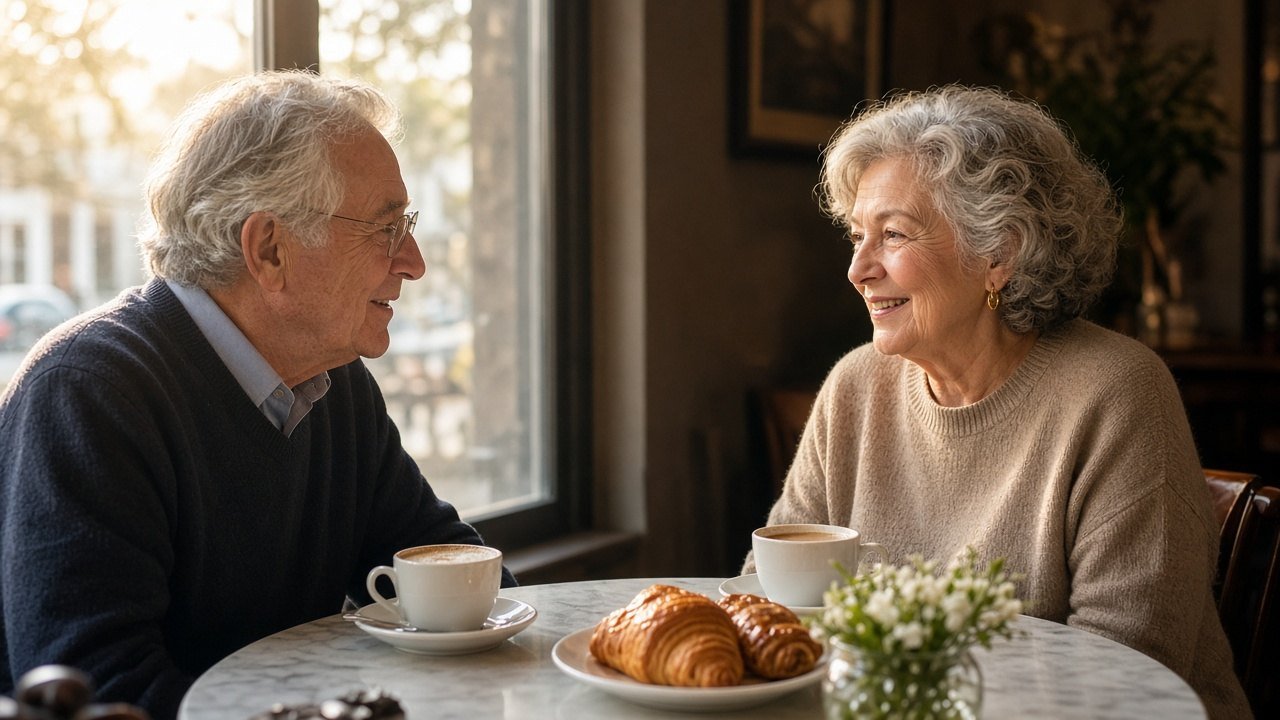
The practical answer is to lower the effort per outing. Choose a venue you already know, keep the trip short, and leave while you are still enjoying yourself rather than waiting until you are worn out. A daytime coffee beats a long evening when driving in the dark has stopped feeling easy.
How do you know you’re ready?
Readiness usually shows up in small behaviours rather than a big announcement.
You might recognise that the thought of a coffee meet-up feels curious rather than exhausting, that you can talk about your late spouse without being pulled under for the whole day, and that you can tolerate polite questions about your life.
Readiness also means you can say no without guilt and you are not looking for someone to save you from grief. If grief still dominates your weeks, start with bereavement support rather than a date.
The UK government’s bereavement guidance points people to Cruse Bereavement Support, the National Bereavement Service and other organisations.
Grief does not have to be finished, but it does need to be manageable enough that another person is not carrying it for you.
A simple test I would suggest is to imagine a pleasant hour with a stranger and no outcome attached. If that picture feels light, you are probably ready enough to try a coffee.
If it feels like an audition, give yourself more time and keep your social life ticking over in the meantime.
Early conversations often turn to the person you lost, and that is not a problem in itself. A short, warm mention usually lands better than either silence or a long history.
You are allowed to say that you loved someone deeply and that you are here anyway.
What if you want companionship but not marriage?
That is a valid and increasingly common place to land. For some people, dating after 70 and widowed means companionship rather than marriage, and that is a perfectly reasonable goal.
Work out what you are actually offering before you look. A clear sense of your own limits saves a difficult conversation later, and it filters out people whose plans are very different from yours.
Companionship can include dinners, travel, phone calls, shared hobbies or living apart while still showing up for each other. You do not have to combine households, share finances or describe a relationship to grandchildren as serious.
The honest conversation with a potential partner is what matters. Say clearly that you enjoy their company but are not looking to marry or move in together.
If the other person wants more, it is kinder to know early.
When you are ready to look at profiles from other seniors, Dating for Seniors is one place to start.
See Dating for SeniorsWhat is the safest way to meet people?
Treat every first meeting as a low-stakes social outing, not a date with a future. Meet in a busy public place during daylight, arrange your own transport, and tell one trusted person where you are and when you expect to be home.
If you use an online dating site, keep financial details completely private until you know someone well in person over many weeks.
Video calls before an in-person meeting can help you verify that a person is who they say they are, but they are not a substitute for a careful public first meeting.
One red flag deserves its own paragraph: anyone who asks for money, gift cards or bank details, however warm the story attached to it. Scams of this kind rarely open with a demand.
They tend to begin with daily affection and then a sudden emergency. Keep those two things separate in your mind and the pattern becomes easier to spot.
5 easy tips for a gentle start
A gentle start is often the difference between a pleasant chapter and an exhausting one. I favour these steps because they protect your time, money and peace of mind while still moving you forward.
- Start with friendship, not romance. Call it a walk, a coffee or a class, and leave the word date out of the first meeting.
- Keep one familiar weekly activity. A hobby, service or friendship group that belongs only to you keeps your week from revolving around a new person.
- Set a check-in plan. Tell one friend or family member where you are going and roughly when you will be back.
- Practise saying no. If someone rushes you, asks for money or makes you uneasy, you owe them nothing further.
- Delay money and private details. Financial help and personal documents should wait until trust has been built face to face over time.
How do you handle family reactions?
Family worry often comes from two places: their own grief for your late spouse and their fear that you will be hurt or taken advantage of. You do not need permission to date, but you can reduce conflict by being calm and clear.
Tell them what you are doing, not what you are asking. Expect opinions, answer only what feels comfortable, and keep boundaries around your private conversations.
If they raise safety fears, share your precautions instead of dismissing them.
I have covered a broader look at finding love after 50 in another article, which may help if those family worries sound familiar.
Grandchildren often need only a simple, calm sentence, and they take their cue from the adults around them. Give them time, and let a new friendship become ordinary before it becomes a family announcement.
If a senior dating site might help, you can take a look at Dating for Seniors here.
Join Dating for SeniorsFrequently asked questions
Do I have to use dating apps at this age?
No. Apps are optional. Many people prefer introductions through friends, community groups, church, volunteer work or classes. The main thing is to meet people consistently in low-pressure settings where you can talk and observe character.
How long should I wait after being widowed?
There is no fixed timeline. Some people feel open after a year, others after several years, and some decide they never want another partner. Your timetable is valid as long as you are honest with anyone you meet.
Is it disloyal to date again?
Dating again does not erase your late spouse or the years you shared. Many widowed people describe it as adding a new chapter rather than replacing the old one. Only you can define what loyalty means in your own life.
What if my children strongly object?
You can listen without handing over the decision. Children may need time to adjust, and their worry often softens when they see you being careful, happy and still fully engaged with family life.
How do I stay safe from romance scammers?
Never send money, gift cards or financial details to someone you have not met in person. Keep first meetings public, verify slowly, and be suspicious of intense affection that arrives before trust has been earned.
Honest take
In my view, dating after 70 and widowed is not about becoming the person you were. It is about giving yourself permission to be a slightly different person now.
The one mistake I would warn against is treating loneliness as a reason to ignore red flags. If you keep your pace, money and boundaries safe, a new connection can be a respectful companion rather than a replacement for the life you had.
References
- Pew Research Center. The Virtues and Downsides of Online Dating. 2020. https://www.pewresearch.org/internet/2020/02/06/the-virtues-and-downsides-of-online-dating/
- National Institute on Aging. Loneliness and Social Isolation: Tips for Staying Connected. https://www.nia.nih.gov/health/loneliness-and-social-isolation/loneliness-and-social-isolation-tips-staying-connected
- PubMed. Widowhood dating older adults search results. https://pubmed.ncbi.nlm.nih.gov/?term=widowhood+dating+older+adults
- GOV.UK. Bereavement help and support. https://www.gov.uk/after-a-death/bereavement-help-and-support
Have fun,
Ray.
This post contains affiliate links; I may earn a commission at no cost to you.